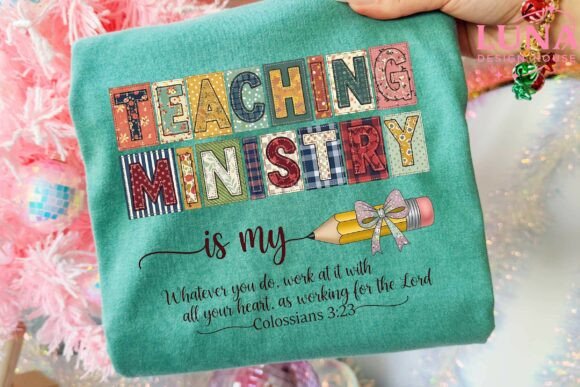
Teaching Ministry Christian Teacher PNG
A Design That Speaks Before the Needle Moves
When I opened Teaching Ministry Christian Teacher PNG for the first time, what struck me wasn’t just the subject—it was the quiet intention behind it. This isn’t a flashy, trend-chasing graphic. It’s warm, reverent, and grounded—like a handwritten note tucked into a teacher’s lesson plan binder. The composition balances soft curves with clear letterforms, and the central motif (a subtle cross or open book, depending on the version) anchors the message without crowding it. As an embroidery designer who’s stitched hundreds of faith-based pieces for churches, schools, and small shops, I immediately saw its natural home: not on a crowded t-shirt chest print, but on a well-loved tote bag for Sunday school volunteers—or a linen apron for a homeschool mom who teaches Bible study over coffee.
Where It Shines in Real Embroidery Projects
I tested Teaching Ministry Christian Teacher PNG across three real-world applications: a medium-weight cotton tote, a fleece-lined sweatshirt, and a 100% cotton tea towel. On the tote, the design held clarity at 3.5" wide—no feathering, no thread pooling. The satin stitch edges stayed crisp, and the fill stitch density felt generous without being stiff. On the sweatshirt, I used tear-away + cut-away stabilizer combo, and the result looked professionally finished—not “crafty” but *considered*. Even the smallest details—the curve of the “C” in “Christian,” the spacing between “Ministry” and “Teacher”—held up under stitching.
It’s especially effective for baby embroidery and nursery decor: scaled down to 2.25", it reads beautifully on a onesie or pillow cover, where simplicity and legibility matter more than ornamentation. For holiday embroidery—think Christmas teacher gifts or Easter-themed classroom appreciation—it adds sincerity without cliché. And for Etsy sellers and boutique owners? It pairs effortlessly with neutral apparel: oatmeal sweatshirts, navy totes, cream tea towels. Customers don’t see “just another religious design”—they see *recognition*, like spotting a familiar face in a crowd.
Where Caution Is Warranted
This design isn’t built for every surface—and that’s okay. On highly textured fabrics (like bouclé or heavy terry cloth), the fine interior lines can blur unless you adjust stitch density or add extra stabilizer. Stretchy knits—especially lightweight t-shirts—require careful hooping and possibly a light water-soluble topping to prevent skipped stitches in tighter curves. And while the lettering is clean, it’s not ultra-bold: below 2", the “g” and “y” in “Ministry” risk losing definition on dark fabric unless paired with high-contrast thread (e.g., bright white or ecru on navy).
Curved surfaces like caps or curved pillow edges demand thoughtful placement. I tried it centered on a structured baseball cap front—good result, but only because I reduced width to 3.25" and avoided the crown seam. Tiny corners (like the top edge of a patch border) may need manual cleanup in your embroidery software if the original vector wasn’t optimized for tight radii. Also, avoid layering this directly over seams or darts without testing first—the design’s gentle symmetry can distort if the fabric shifts mid-stitch.
What It Adds to Your Finished Product
- Visual appeal: Feels handmade but polished—no pixelation, no jagged edges when converted properly to an embroidery file.
- Stitching clarity: Balanced satin and fill areas mean fewer thread breaks and smoother transitions between elements.
- Product value: Elevates simple items—a plain tote becomes a meaningful gift; a basic sweatshirt becomes a statement piece for church staff.
- Customer trust: Clean execution signals professionalism. Buyers associate tidy stitching with care—and care translates to repeat orders.
- Brand consistency: Works seamlessly alongside other faith-based designs in your shop, especially if you’re curating a cohesive “teaching ministry” collection for small churches or Christian schools.
Practical Designer Notes You’ll Actually Use
Before stitching Teaching Ministry Christian Teacher PNG on your next project, do these five things:
- Test on scrap fabric first—same weight and weave as your final item. Watch how the fill stitch settles and whether any thin lines vanish.
- Check thread color contrast in natural light. What reads clearly on screen may disappear on charcoal fleece or heather gray.
- Review stitch density in your embroidery software. If it’s over 12,000 stitches, consider simplifying small interior shapes for delicate fabrics.
- Confirm hoop size compatibility. At full scale, it fits comfortably in a 4x4 hoop—but verify before loading onto your machine.
- Inspect small details at 200% zoom: are serifs intact? Do letters have consistent kerning? If not, minor tweaks in your editing software will pay off in stitching.
Also: run a black-and-white mockup to assess tonal balance, compare light/dark fabric backgrounds side-by-side, and always use appropriate stabilizer for your fabric type. And crucially—if you’re selling finished embroidered items or reselling the digital embroidery file itself, double-check licensing terms. Not all T-Shirt Designs assets permit commercial embroidery or resale as digital embroidery files. When in doubt, contact the creator.
Final Thought: A Quiet Anchor in a Busy Niche
In a market flooded with loud, overly decorated Christian graphics, Teaching Ministry Christian Teacher PNG stands out by choosing restraint. It doesn’t shout—it invites. That makes it unusually versatile: equally at home on a baby’s onesie, a pastor’s apron, or a boutique’s limited-run sweatshirt line. It’s not just a machine embroidery design. It’s a small act of recognition—crafted for people who teach, lead, and serve quietly. For embroidery designers and creative entrepreneurs building trusted, human-centered brands, that kind of resonance isn’t just nice to have. It’s essential.